

Image
Money, Wizards & Populism: What Today’s Economy Is Really Telling Us
Intro Text
Michael Litt brings his unique perspective to The CCIM Institute 2026 Spring Forum
April 21, 2026
“Life moves pretty fast.” The famous Ferris Bueller quote used early in this presentation isn’t just nostalgic—it’s a warning. In today’s economic environment, if you don’t stop and look around, you may miss the structural shifts redefining markets, policy, and real estate.
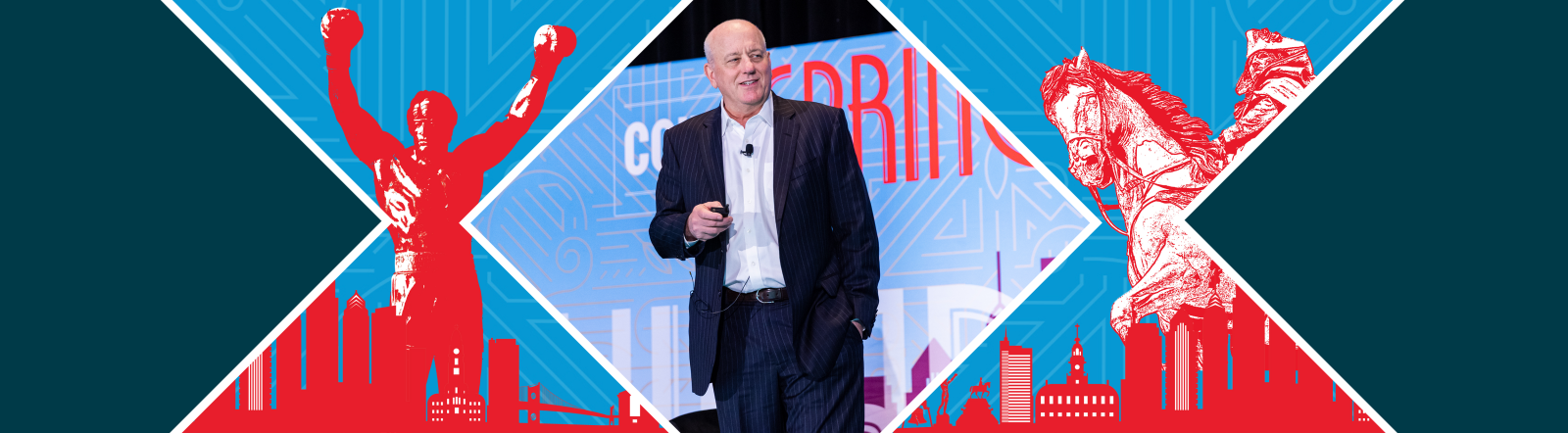
That was the thesis of the hotly anticipated presentation by Michael Litt, Chairman of the Board for Bareburger, and inspiration behind the best-selling book “The Big Short,” as he presented to sold-out crowds on April 20, 2026, during The CCIM Institute Spring Forum in Philadelphia.
Litt began by framing money not simply as currency, but as a foundational technology—one that has repeatedly reshaped economic systems and political power structures throughout history. He pointed to early examples such as Lydian coinage and the Greek Tetradrachm, explaining how innovations in money increased the velocity of trade and contributed to broader societal shifts, including the rise of democratic systems. At the same time, he noted that monetary systems have historically been vulnerable to political influence and mismanagement, citing the debasement of Roman currency as a factor that coincided with the empire’s decline.
From there, Litt transitioned to the modern era, arguing that a blend of competing policy frameworks shapes today’s U.S. economic environment. He described the current landscape as an “admixture” of federalist, populist, Jeffersonian, and isolationist approaches—each pulling in different directions. According to Litt, this combination has introduced countervailing forces into the economy, contributing to uncertainty for investors and business leaders alike.
Despite this uncertainty, Litt highlighted several indicators suggesting that parts of the financial system remain stable. He pointed to strong bank capitalization levels and relatively low consumer debt-service burdens, even in a higher-interest-rate environment. Mortgage delinquencies, he noted, also remain historically low. However, he cautioned that these headline indicators may obscure emerging risks elsewhere in the system.
One area of concern, according to Litt, is the growing role of private credit markets. He emphasized that private credit has expanded rapidly in recent years, with significant exposure to sectors such as software and SaaS companies. At the same time, he observed that artificial intelligence is beginning to disrupt parts of the software industry, potentially creating stress within those same credit portfolios. He also noted increasing redemption pressure in private credit funds, suggesting that liquidity conditions may be tightening.
Litt further argued that liquidity—or the lack of it—is becoming a central theme across asset classes. As liquidity retracts, he explained, asset values tend to decline broadly, affecting commodities, real estate, and other investments. This dynamic, he suggested, represents a shift from the types of risks seen during the 2008 financial crisis.
Turning to real estate, Litt described a market characterized by significant divergence. In the residential sector, he pointed to substantial wealth creation, noting that a large portion of U.S. homeowners now hold properties without mortgages. At the same time, he highlighted affordability challenges, with homebuyer traffic falling to levels typically associated with recessionary periods.
In commercial real estate, Litt emphasized that performance varies widely by asset quality and location. Higher-quality, well-amenitized properties are seeing stronger demand, while other segments face ongoing challenges, including rising delinquencies and refinancing pressures. Overall, he suggested that the commercial real estate cycle is likely to experience a prolonged and uneven recovery.
The presentation also addressed broader structural shifts, including the growing concentration in equity markets and elevated valuations in AI-related stocks. Litt noted that the largest companies now make up a significant share of the S&P 500 and that capital intensity among AI firms is increasing, raising questions about sustainability.
Finally, Litt pointed to global risks that extend beyond financial markets. He highlighted physical bottlenecks—such as semiconductor supply chains and energy transit routes—as potential sources of macroeconomic disruption. These constraints, he suggested, represent risks that are difficult to predict and even harder to manage through traditional policy tools.
In closing, Litt’s presentation underscored a central theme: while the financial system may appear stable on the surface, underlying risks have shifted in important ways. For professionals across commercial real estate and investment sectors, understanding these evolving dynamics will be critical in navigating the years ahead.