CCIM Education

STDB Tips

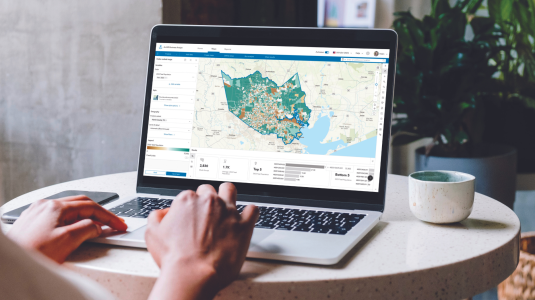
The best proponents for STDB are the CCIM members who use the mapping and demographics program regularly in their daily business. Commercial Investment Real Estate asked CCIMs to share favorite tips for working with this free member benefit.

Alec Pacella, CCIM, NAI Daus, Cleveland, Ohio: The DatabaseUSA is one of the most useful but underutilized tools. While no data vendor can be 100 percent accurate, I have found the DatabaseUSA quality to consistently be as good or better than any of the competing products, including Dun & Bradstreet, Harris, and InfoUSA. The fact that all of these competing products cost hundreds if not thousands of dollars each year makes my annual membership dues for CCIM a no-brainer for this reason alone.

Mark Van Ark, CCIM, KW Commercial - DTC, Boulder, Colo.: I use multiple STDB tools in my practice: uploading a business list, geocoding a client's competition, and determining an appropriate trade area through the creation of a Thiesson polygon. While these sound impressive, they are easy to do. Combine these tools with the various reports you can create, and you will develop an incredible market analysis for your clients.

Nick Nelson, CCIM, Longbow Real Estate Group, Austin, Texas: If I had to track every site plan by pushing a thumbtack into a map, I would never have time to actually sell anything. Instead, our team uses a layer in STDB ArcGis online to track all of our emerging projects in Austin. With a click of the mouse, a CCIM designee in our office quickly determined the site next door was available for the same use his client wanted to build. He saved the client from spending time and money, while establishing himself as a market expert.

Additionally, the STDB business lists and BAO are great prospecting tools. Using the retail gap analysis reports and updated business list searches by NAICS codes, you can easily match the industry codes in the report with the business list to generate a powerful tenant prospecting list. Send the tenant a copy of the report to add value and build relationships.

Richard Juge, CCIM, Re/Max Commercial Brokers, Metairie, La.: I'm representing a seller who has an old survey but didn't want to pay to get a new one. I thought it was important to measure the site in two areas due to the possibility of subdividing it. Also, the site has one sloping angle, which makes measuring difficult. On Google Earth, measuring is a “pro”  feature costing $200+. I could not find a free site among all the shareware.

Fortunately, STDB/BAO has a no-cost solution. On the main maps page, use the right-hand side ruler to open a box for lines versus area. Next enter property in square meters, feet, miles, or other dimensions. That resolved the problem for the seller without the cost of a survey.

George Thomas, CCIM, Whiteside and Grant Realtors, Tulsa, Okla.: Pictometry is one of my favorite STDB tools. I use the high resolution aerial photos showing the property as exhibits. By running a drive-time study for the property's trade area, the map of the trade area is another impressive exhibit.

The Esri “All In One” reports generate much more than a demographic report. In addition to an executive summary, the retail marketplace profile includes a gap analysis, showing what types of businesses are not being served in your study area, allowing you to develop a target market for a property.

J.J. Joubran, CCIM, Joubran Commercial Properties, Greensboro, N.C.: Currently, I work with a residential builder who needed assistance on finding locations for retail sales centers to sell his homes. He requested the sales centers to be within a 15- to 20-minute drive of the subdivisions where he builds in North Carolina, South Carolina, and Florida.

Through BAO's drive time map and imported points tools, I showed my client precisely where a potential sales center could be set up to serve as the “central hub” he wanted within an 18-minute drive. The STDB tools secured the relationship with my client.

Bradbury R. Crumpecker, CCIM, Robinson Clay KW Commercial, Dallas: I'm using STDB smart maps with key variables for my client requirements to help tenants narrow the areas where we look for sites and to assist landlords looking for like-kind demographics areas to find possible users of listed space.

Skip Duemeland, CCIM, Duemelands Commercial, LLP, Bismarck, N.D.: We use STDB all the time to make management decisions about site investments. If it does not pass our STDB criteria, we do not invest in that site.

Beverly Keith, CCIM, Avison Young, Raleigh, N.C.: Tapestry on STDB is what sets my retail team apart from the competition. With franchisor assignments, we can determine the top Tapestry segmentations that lead to the most profitable storefronts and use that information to qualify potential sites. Most retailers do not know their top three Tapestry segmentations.


Continue Reading

Carol Campbell

Carol Campbell is the director of operations for CCIM Tech. Contact her at carol@ccimtech.com.

Advertise with Us

Reach more than 45,000 top-performing commercial real estate professionals with CIRE magazine’s print, podcast, and online offerings.

Download the Media Kit

Recommended

A Return to OZ

Fall 2020

The opportunity zone program continues to thrive despite skepticism and the pandemic. It's only been three years since opportunity zones were created to encourage investment in low-income communities across the country. The program has been welcomed and used by many, though some look on with skepticism. N

Read More

Creating Valuations Amid Uncertainty

Fall 2020

In today’s climate, estimating an asset’s current and future worth is tricky but far from impossible.

Read More

Making the Most of Using Less

July.Aug.19

Today’s construction industry operates with a triple bottom- line perspective: construction must be financially sustainable, structures must be environmentally sustainable, and construction must be socially sustainable. Here are eight common methods of reducing consumption, eliminating waste, and minimizing energy usage.

Read More

Retail Analysis

March.April.19

The retail property feasibility analysis featuring the CCIM Strategic Analysis Model considers the goals and objectives of the investor/developer, alternative investments available, and the investment criteria that lead to the final decision.

Read More