CCIM Q&A
Retail Forecaster
By Sara S. Patterson |
The
dynamic intersection of online and in-store sales is changing many dimensions
of the retail marketplace, according to Gary M. Ralston, CCIM, CRE, SIOR, a
managing partner of Coldwell Banker Commercial Saunders Ralston Dantzler Realty
LLC in Lakeland, Fla. He contends the high cost of the last mile in retail
limits the expansion of online sales but also forces in-store retailers to
discover new ways of conducting business that maximize efficiency. Ralston
shares his retail expertise with Commercial Investment Real Estate.
CIRE:
Will online retail sales ever surpass those in brick-and-mortar stores?
Ralston:
Under current conditions, that outcome is unlikely. In 2013, e-commerce was
slightly less than 6.5 percent of retail sales (retail and food services sales,
excluding automotive sales). It is important to recognize that retailing is the
final step in distributing merchandise to consumers. In other words, retail is
a logistics-based business.
In the
retail logistics model, the “last mile” from the store to the consumer’s home
is the most inefficient link. For example, about one-third of Amazon’s sales
are purchases that do not need to be delivered. Sales of Internet-delivered
products and services will continue to favor e-commerce. Sales of physical products
(merchandise also found on the shelves of stores), however, will probably not
reach very far into double digits due to constraints associated with the cost
of the last mile. Store pick-up of online purchases, however, will grow
exponentially.
CIRE: How
are showrooming (seeing products in brick-and-mortar stores and ordering them
online), easy price comparisons, and informed consumers transforming the retail
industry?
Ralston:
More than anything else, the Internet has created informed consumers in the retail
sector. In effect, power has shifted from the retailer to the consumer.
Consumers can search for comparative pricing from their computers at their
homes or offices, as well as easily use their mobile devices while in the store
to research products and search for the lowest price. This activity forces the
retailer to price match. As a result, the consumer gets the lowest available
price, and the retailer immediately captures the sale.
CIRE:
How do these new retailing trends relate to how retailers lease space today?
Ralston:
Price matching puts pressure on the retailer’s gross margin. CCIMs understand
that financially feasible rent for a retailer is a function of sales at the
subject location (demand at the point of local supply), coupled with the retailer’s
gross margin. That translates into retailers seeking lower rent.
Retailers
are also offsetting the pressure on gross margin by seeking to increase sales
per square foot. Retailers are using technology tools to create more-efficient
inventories, eliminating products that account for lower sales and promoting
in-store pickup of online purchases. This translates into smaller stores, which
generate higher sales psf to offset the financial impact of lower gross margins
and maintain financially feasible occupancy costs.
CIRE:
How does a feasibility analysis figure into retail projects today?
Ralston:
CCIMs use the financially feasible rent model to target retailers with higher
sales psf and/or higher gross margins. There is also a trend toward a higher
percentage of shopping center space being occupied by non-retail businesses.
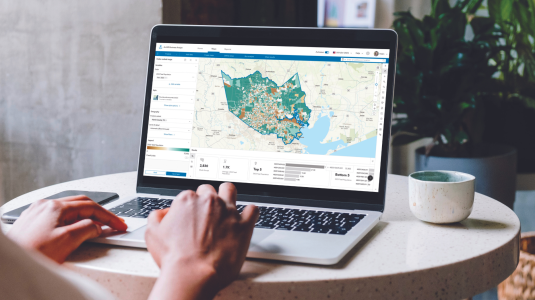
Using geographic information system tools to analyze demand within a defined
trade area allows for targeting retailers and other users that would be the
most productive at a specific location. The feasibility analysis model is
important in consideration of both acquisitions and development.
CIRE:
How does the trend toward smaller, more productive retail space play out during
the next round of new retail development?
Ralston:
Several impacts are apparent. For example, retailers expanding their number of
stores will likely reduce the footprint (square footage) of their prototype
store. Also, there will be more redevelopment and reconfiguring space to meet
the needs of retailers who are seeking smaller footprints. This is particularly
true when retailers merge or downsize, and landlords are left with boxes, which
require subdivision into smaller units. Another key trend will be providing
space for nonretail tenants, especially health care.
CIRE:
How has the designation and your affiliation with CCIM improved your ability to
analyze the market dynamics of the retail industry?
Ralston:
My CCIM training and my commitment to continuous learning have allowed me to
find more investment opportunities. For example, the misinformation in retail
real estate sector creates opportunities for well-informed, astute investors
and operators to outperform the overall commercial real estate market.
Sara S.
Patterson is senior editor at Commercial Investment Real Estate.